Using honey for wounds is nothing new, with its properties extolled over many centuries as an aid to healing and for reducing inflammation. For many a miracle cure, for the more scientific it simply combines properties that aid debridement and decontaminate wounds to aid the smooth progression of healing through the inflammatory phase.
Because of its high osmolarity, honey draws lymph into the wound, providing necessary nutrients for tissue regeneration. Honey also provides amino acids, vitamins, enzymes and minerals, which increase the speed of granulation
Honey (of all types) offers the
wound several benefits due to its “natural” high sugar content, which creates an osmotic effect in the wound, a low pH which inhibits microbial proliferation, and some key enzymes which create an antimicrobial effect similar to that adopted by neutrophils.
Because sugar draws moisture from the wound’s bacterial environment, it inhibits bacterial growth. However, as sugar becomes diluted, less water is removed from the wound, potentially enhancing bacterial growth. This is the reason “sugar bandages” have to be changed twice daily initially, or more frequently if strike-through is noted.
Like honey, sugar deodorizes the wound, decreases edema, attracts macrophages, speeds up debridement and forms a protective layer.
The more recent research into the specific antimicrobial properties of mono-floral “manuka” (Leptospermum scoparium) derived honey found that its antimicrobial effect is
enhanced by the presence of methylgloxal, a plant-derived phytochemical, which offers a potent antimicrobial effect independent of the pH, enzymes and sugars.
But Wait Honey, There’s More!
Honey also has antibacterial properties through four mechanisms: it lowers the wound’s water content (aka, it increases its osmolarity); it is highly acidic (pH 3.6-4.5); it attracts macrophages; and it is a substrate for ongoing production of a very low concentration of hydrogen peroxide (H202), which kills bacteria.
The concentration of H2O2 that accumulates within one hour is approximately 1,000 times less than in the 3% H2O2 that is commonly used in practices thus making it harmless for tissues.
More Sugary Benefits
It offers more protection against infection and disease because of its powerful chemical components:
- Methylglyoxal (MGO): a naturally occurring chemical compound in Manuka honey that can vary between different Manuka honey … remember this player for later in the post.
- Dihydroxyacetone (DHA): found in the nectar of Manuka flowers … and converts into MGO during the honey production process.
- Leptosperin: a naturally occurring chemical found in the nectar of Manuka plants.
These components give Manuka honey longer-lasting antibiotic, antiviral and antifungal effects …
That’s because they’re not used up as quickly in the healing process compared to other types of honey … which have only hydrogen peroxide available as their main chemical defense.
Lab tests have found that it can successfully treat approximately 60 species of bacteria!
Contraindications
- Bleeding wounds.
- Healthy granulating wounds.
- Epithelialising wounds.
Considerations
Due to the osmotic action of honey, the exudate level in the wound will likely increase during use and an absorbent secondary dressing is required. Use of a barrier cream such as Cavilon (3M) around the wound will help to prevent excoriation to the surrounding skin if exudate levels are high. Manuka honey can be used in wounds with post-surgical dehiscence although it should be considered that dissolvable sutures may break down more rapidly as a result. It is a decision for the clinician based on each wound they are facing and the role the sutures play. If the sutures are achieving little but a foreign body effect, it may be better to remove them and explore what is going on beneath and any application of manuka honey can have maximum contact with the wound bed.
Presentations
- Tube: for application into cavities and abscesses.
- Dressings: presentations include gauze, alginate sheets and ribbon, hydrocolloid, and impregnated polyurethane foam.
Some DIY tips
Most brands of manuka honey can be diluted by up to 50% while maintaining an antimicrobial effect. This means there are some additional ways it can be used for specific wounds.
- Manuka honey solution – medicalgrade manuka honey squeezed into a syringe with up to 50% warm saline added and shaken to make a solution. This solution can be used to flush into pocketing wounds or beneath areas of dehiscence, or to moisten gauze intended for wet-to-dry application giving a level of antimicrobial and osmotic action.
- Manuka honey gel – medical-grade manuka honey can be mixed up to 50:50 with a hydrogel to create an osmotic gel. This may be particularly helpful for cases of burns or where tissue loss is extensive.
Wear time
Manuka honey dressings can be left on a wound for around five days, assuming there is honey still available in the dressing during the contact time. The impregnated dressings such as Algivon combine the absorbency of alginate with a high loading of medical-grade manuka honey to create a soft gel that should last several days. Manuka honey from a tube will not last so long, but can be placed into cavities, onto gauze and tied to achieve your own versions to suit the patient.
The fact is, each wound is different depending on the location and the size of the patient (e.g. cat versus horse) so exudate levels vary and wear time will need to be adapted to suit. It would be reasonable to expect the most powerful response to honey to be on the first application when the
osmotic action coincides with a peak in the inflammatory phase and a high level of exudate. Therefore one to two days’ wear time would be realistic combined with an absorbent dressing. As inflammation subsides then the wear time can be increased to up to four days, to which point a healthy granulation bed is achieved. If there is honey left on the dressing on removal, you may well have taken it off a little early; if there is no honey to be seen, you may have gone a little too long.
Why not use it for everything?
Wound healing is a cycle that is optimised through the phases of healing firstly by aiding debridement during the inflammatory phase (days one to four) and then by maintaining a moist environment to support angiogenesis and fibroplasia that will fill the deficit and enable wound contraction (day four onwards). The high-sugar, low pH environment provided by honey will have a negative impact on fibroblast activity and may contribute to the formation of exuberant granulation. This certainly seems to be the case anecdotally. Once honey has helped to achieve the aims of debridement, it is ideally replaced with a hydrogel that is more sympathetic to the proliferative phase
Preventative Health
Protect With Antioxidants
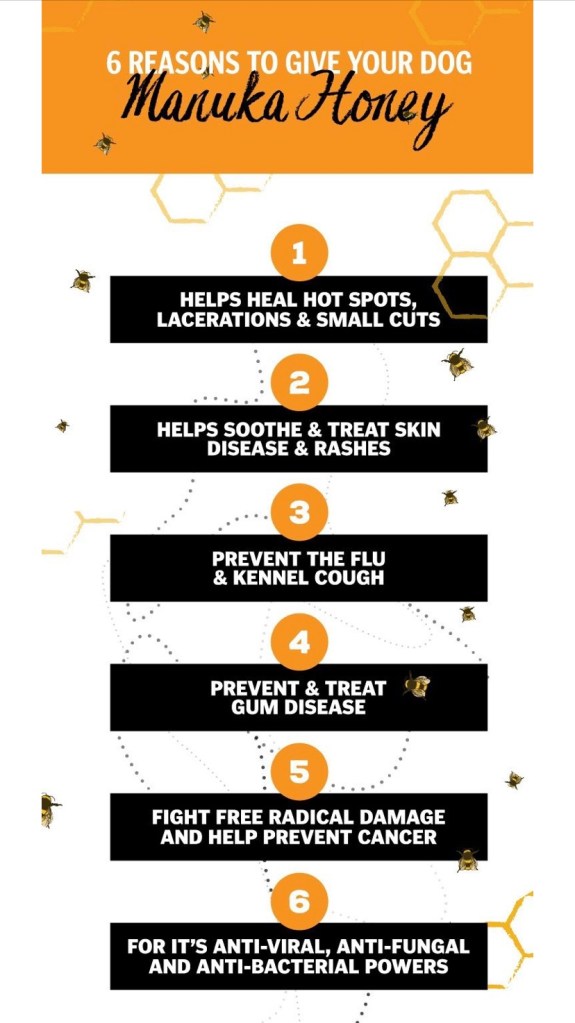
You need to support your dog with antioxidants to keep disease and cancer at bay.
Antioxidants slow the aging process and boost your dog’s immune system.
They repair and restore the body’s cells to fight free radical damage which is a tough job in a world with many environmental toxins and it’s hard to avoid things like …
- air pollution
- pesticides and fertilizers used in park spaces
- microwaves from our technology devices
… but you can feed antioxidants to combat this damage.
One study looked at the flavonoids and phenolic acids found in Manuka honey … and they had a big antioxidant benefit.
Vitamin C is one of the top antioxidants at fighting cell damage and preventing cancer … and this honey offers you a sweet way to give your dog vitamin C.
And it also has a good supply of B vitamins… and these good guys also help the body fight off infections and support good gut health.
Provide Added Immune Support Against Viruses
By boosting the good bacteria in your dog’s gut with Manuka honey you can strengthen his immune system.
Manuka honey also has anti-viral properties added immune protection.
If your dog is happy and healthy he’s at less risk of getting sick from a virus.
But there are things in life that can lower his natural protection and a big one is stress.
Stress weakens the immune system … putting your FURkid at higher risk of becoming ill from a virus or bacterial infection.
Two common illnesses found in stressed-out dogs are dog flu and kennel cough.
Boarding is stressful for dogs. That’s how kennel cough got its name … as it’s common in dogs in kennel environments.
But sometimes stress can’t be avoided.
If your dog travels for competitions … or is lucky enough to be your number one travel companion, he’s at a higher risk.
The good news is you can use Manuka honey orally to boost his anti-viral immune health.
Try offering it orally as a preventive step before dogs shows, traveling or if he will be meeting new dogs.
Prebiotic Support For Gut Health
Gut health is essential to overall health. About 80% of the immune system starts in the gut. So you want to do everything you can to make sure your dog’s digestive system has a good balance of bacteria.
Manuka honey is a natural prebiotic that can play a role in maintaining the right bacterial balance. Probiotics are the good bacteria your dog needs. And prebiotics fuel the probiotics and help them thrive.
This means your dog will have the resources to rev up his natural immune response … and heal faster.
So if you’re treating your dog with Manuka honey for a wound or skin issue … don’t forget to sneak some into his meals for prevention too!
Manuka Honey is the 🐝 Bee’s Knees!
 Mindful Paws PR