
Declawing cats is not a matter of just removing the nail. Instead, the last joint on each toe is surgically removed, preventing the claw from growing back. It is cruel and causes pain, lifetime suffering, and behavioral issues.
People often mistakenly believe that declawing their cats is a harmless “quick fix” for unwanted scratching. They don’t realize that declawing can make a cat less likely to use the litter box or more likely to bite. Declawing also can cause lasting physical problems for your cat.
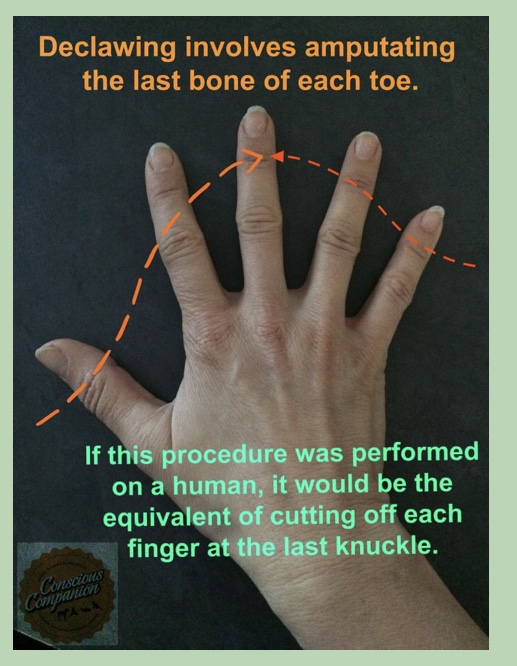
In comparison, on a human being, it would be like cutting off each finger at the last knuckle. Now…gimme your 🐾 paw! 😡😤
PAWSitively Inhumane
- Declawing is amputation: What most people do not realize is that declawing the cat requires amputation of the last digit. In a human, this would be the same as cutting off each finger at the last knuckle.
- Regarding complications with the declawing procedure: Complications occur in over one half of patients and include pain, bleeding, damage to the foot pads, lameness, swelling, infection, and regrowth of the claw.
- Declawing can cause litter box issues: For several days after surgery, shredded newspaper is typically used in the litter box to prevent litter from irritating declawed feet. This unfamiliar litter substitute, accompanied by pain when scratching in the box, may lead cats to stop using the litter box.
- Declawed cats may have painful, physical problems: Once their claws have been removed, they can no longer perform their natural stretching, scratching, and kneading rituals. It is important to understand that scratching is normal behavior for cats, which has an inherent function. The primary reason cats scratch is to maintain the necessary claw motion used in hunting and climbing, as well as a means to stretch their body. Scratching serves to groom the front claws and leave markers of the cat’s presence. A cat’s claws grow in layers and scratching removes the worn outer layer to expose the new growth inside. Cat owners must therefore provide alternatives for cats such as suitable scratchers. If this ritual is prevented, they may become weaker and those scratching muscles will atrophy as they age and may experience debilitating arthritis in their backs and shoulders.
- Walking becomes unnatural for a declawed cat: Cats walk on their toes, and declawing leads to changes in gait due to weight now being placed on the second phalanx. Furthermore, over time, the severed tendons may shrink, resulting in the bone curling down, giving a clawed appearance to the foot. Immediately after declawing, more weight is shifted to the back feet, altering the cat’s gait. Over time, the weight is re-distributed between the four feet, however the second phalanx was not designed to be a weight bearing bone, resulting in an altered gait and the possible development of arthritis in later years.
If you are concerned about your cat damaging your home, or want to avoid unwanted scratching, try these tips:
- Keep their claws trimmed to minimize damage to household items.
- Ask your veterinarian or groomer about soft plastic caps (like Soft Paws®) that are glued onto the cat’s nails. They need to be replaced about every six weeks and they grow out naturally with the nail. They are easy to apply and come in fun colors!
- Provide scratching posts and boards around your home. Offer different materials like carpet, sisal, wood, and cardboard, as well as different styles (vertical and horizontal). Use toys and catnip to entice your cat to use the posts and boards.
- Attach a special tape (like Sticky Paws®) to furniture to deter your cat from unwanted scratching.
Power To The Paw! 🐾
 Mindful Paws PR