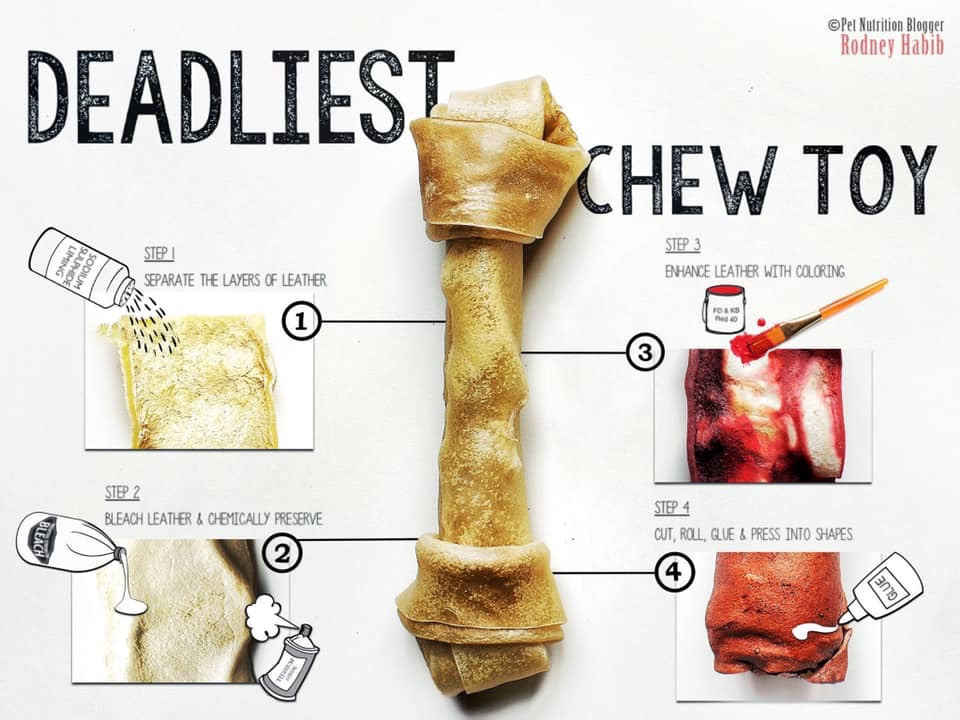
How can one of the most popular chew sticks on the planet be so dangerous for your pets?
As a licensed Vet Tech, I have personally triaged dogs and assisted on many emergency surgeries from dogs consuming rawhide; either choking on it or developing dangerous bowel obstructions. Just check the product label. It ACTUALLY warns that these exact incidences can happen. Another major concern (besides intestinal blockage, pain, bloat, choking and death!) is where these rawhide chews are made.
So, let’s start with what the heck rawhide really is. The name ‘rawhide’ is technically incorrect. A more accurate name would be ‘processed-hide’, as the hide (skin) isn’t raw at all.
Rawhide is not dehydrated-meat or the by-product of the beef industry. Rawhide is actually the by-product of the “Leather Industry”, so theoretically it is a leather chew. Rawhide chews are made from the leather industry’s leftovers. Most hides are taken directly from the kill floors at slaughterhouses and placed into high-salt brines, which helps slow their decay (Insert gag reflex here!).
“Producing rawhide begins with the splitting of an animal hide, usually from cattle. The top layer (grain) is generally tanned and made into leather products, while the inner layer, in its “raw” state, goes to the dogs.” (TheBark.com )
The following is a paraphrased tutorial by The Whole Dog Journal from a few years ago. It explains in scary detail just how this toxic leather is processed and how it ends up in cute little enticing shapes and marketed directly to unassuming Pet Parents who innocently believe that rawhide is a dried “meat stick” and will release stress and reward our fury BFF’s with hours of fun. Wrong!
STEP 1: Normally, cattle hides are shipped from slaughterhouses to tanneries for processing. These hides are then soaked in brine and treated with a chemical bath to help “preserve” the product during transport and to help prevent spoilage. Keep in mind, some of these hides are shipping from China and other countries which means more chemicals as brine alone does not preserve.
Once at the tannery: the hides are soaked again and treated with either an ash-lye solution or a highly toxic recipe of sodium sulphide liming. This process will help strip the hair and fat (yuck!) that may be attached to the hides themselves. These hides are then treated with more chemicals that help “puff” the hide, making it easier to split into layers.
The outer layer of the hide is used for goods like car seats, clothing, shoes, handbags, luggage, etc. But, it’s the inner layer, (along with gelatin and glue!) that is needed to make the rawhide.
STEP 2: Now that we have the inner layer of the hide, it’s time to go to the post-tannery stage! Hides are washed and whitened using a solution of hydrogen peroxide, bleach (and even harsher chemical whiteners). These chemicals will also help mask the smell of the rotten leather. Yummm! 😡🤮
STEP 3: Now it’s time to make these whitened sheets of “leathery by-product” look delicious! This is where the creative artistic process comes in.
“Basted, smoked, and tinted (painted) products can be made literally any color (or shape and scent) underneath the coating made of yet more dyes and preservatives. They can even be painted with a coating of titanium oxide (what???!!!) to make them appear whiter and aesthetically pleasing from a merchandising perspective.”
“…the Material Safety Data Sheet reveals a toxic confection containing the carcinogen FD&C Red 40, along with preservatives like sodium benzoate. But tracking the effects of chemical exposure is nearly impossible when it’s a matter of slow, low-dose poisoning.”– (thebark.com)
STEP 4:
Because the FDA does not consider these chews to be “food”, it’s an open market when it comes to the manufacturers. You see, with no restrictions on these leather strips (since they are not considered consumable food by the FDA), they are free to add basically anything to these chewies, to ensure that they last forever. Any type of glue may be added to get them to hold together and last forever. WHEN TESTED: Lead, arsenic, mercury, chromium salts, formaldehyde, and other toxic chemicals have been detected in raw hide chews. .
Rawhide chews start out hard, but as your dog works the chew it becomes softer, and eventually he can unknot the knots on each end and the chew takes on the consistency of a slimy piece of taffy or bubble gum. And by that time your dog cannot stop working it — it becomes almost addictive.
 Some Healthy Alternatives to Rawhide:
-Antlers. Deer and elk antlers are fantastic treats for your pet.
-Sweet Potato Chews. Sweet potatoes are the ultimate light snack for your pup and good for the digestion. HOWEVER very high in carbs. So moderate.
-Frozen Carrots. Frozen carrots are natural treats that most dogs love.
-Greenies
-Bully Stix
-Zuke’s Dental 🦷Bones
-Chew-A-Bulls
-Collagen
PAWmaste!
Dorothy Cline



 EXTEND CRATE TIME
 Mindful Paws PR